Lighting: Build a Repeatable Light Setup
When your light stand moves twenty centimetres between sessions, your portfolio stops looking like a coherent body of work. Marking a single, honest lighting geometry on your floor lets you compare a sheer summer skin look photographed in March directly beside a graphic editorial liner shot in November.
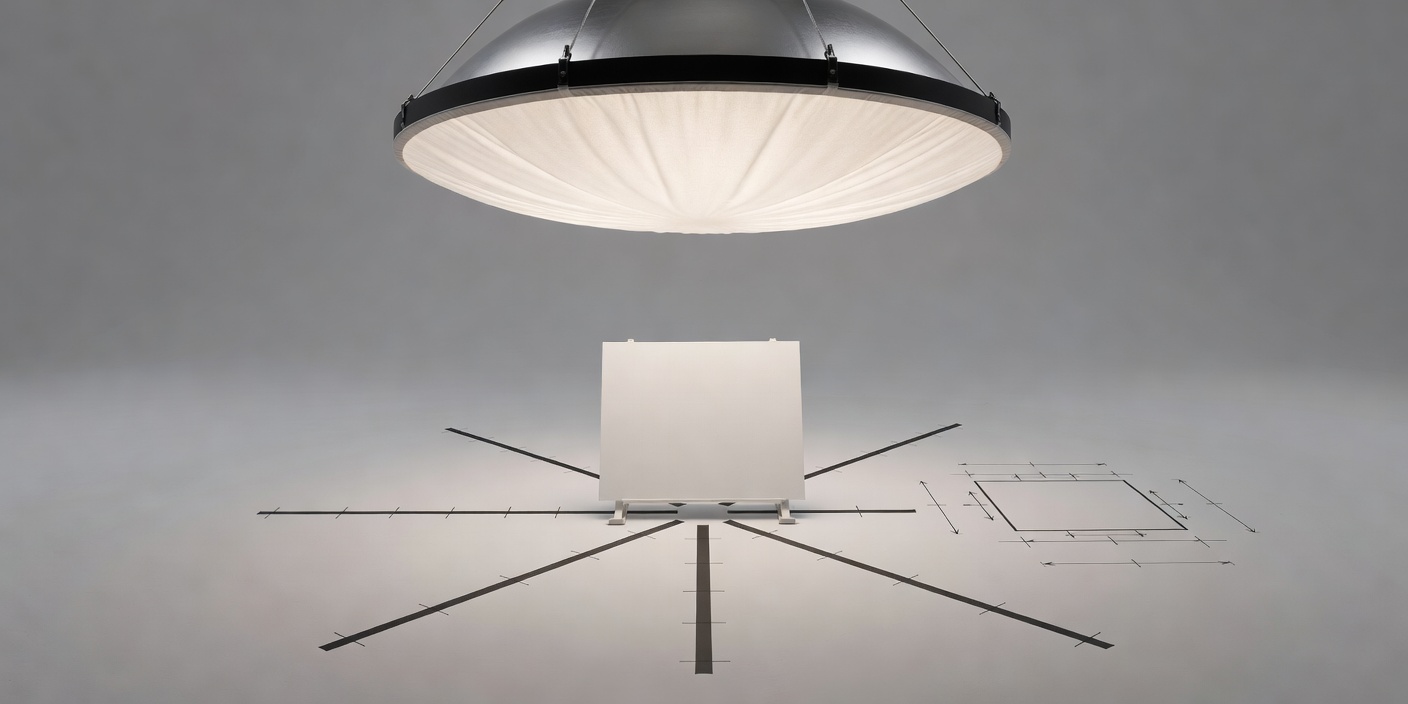
Why Spectral Quality Comes Before Modifier Shape
Before choosing between a softbox, an umbrella, or a beauty dish, verify what wavelengths your lamp actually emits. Inexpensive domestic LED bulbs and basic ring lights frequently score around 80 on the Colour Rendering Index (CRI) and below 50 on the critical R9 saturated-red metric. Because human skin tone—and nearly every blush, bronzer, and lipstick—depends on subtle variations of red and iron oxide, a low-R9 lamp drains warmth from the complexion. The camera records skin as slightly greenish-grey, tempting you to add warm saturation in post-production that ruins neutral eyeshadows.
Select continuous COB LED fixtures or studio strobes rated at CRI 95+ / TLCI 96+ with R9 above 90, locked to a fixed daylight temperature of 5500K–5600K. If you work by a north-facing window, measure the incoming light gently and avoid mixing warm household ceiling spots with afternoon sky light.
Standard Clamshell Geometry (Floor-Tape Coordinates)
Mark three short strips of matte paper tape on your floor so you can rebuild this exact setup in under four minutes:
Modifier Comparison: Matching Diffusion to Makeup Finish
Every modifier balances two qualities: shadow edge softness (controlled by the size of the diffuser relative to the face) and specular highlight crispness (controlled by internal baffle reflectivity).
| Modifier Type | Recommended Distance | Catchlight Shape | Best Makeup Finish Match | Watch Out For |
|---|---|---|---|---|
| 55 cm White Beauty Dish + Diffusion Sock | 80 cm – 110 cm | Round with subtle central dimple | Satin complexion, sculpted contour, brushed editorial brows | Positioning too high creates deep sockets under prominent brow bones |
| 90 cm Octabox with Inner & Outer Baffles | 90 cm – 130 cm | Broad soft octagon | Bridal soft-glam, mature skin, velvet matte complexion | Can wash out micro-shimmer if placed directly flat on axis |
| 60 × 90 cm Rectangular Softbox + 40° Grid | 100 cm – 140 cm | Clean vertical window rectangle | High-drama editorial, dark smoky eyes, sculpted bone structure | Requires careful fill card on opposite cheek to avoid heavy contrast |
| 105 cm Deep White Parabolic Umbrella (Diffused) | 120 cm – 160 cm | Large soft circle | Full head-and-shoulders beauty, body glow on collarbones | Spills light onto backdrop in narrow rooms unless flagged |
Controlling Specular Highlights on Dewy, Metallic, and Matte Looks
-
Dewy Skin and Glass Highlighter Without Looking Sweaty
Oil and emollient balms create direct mirror reflections of your light source. If your diffuser has a hot spot in the centre because the internal baffle was left off, that hot spot stamps a bright white patch onto the forehead and nasal bridge. Always install both internal and front diffusion fabrics for dewy skin, and keep a folded sheet of unbleached blotting tissue beside the camera to tap the T-zone between test frames while leaving the cheekbone high point untouched.
-
Waking Up Metallic Foils and Pressed Glitter
Broad, super-soft light makes metallic pigment look like flat satin because every facet reflects the same uniform white sheet. To make micro-glitter sparkle naturally without fake post-production stars, keep your soft main key light for the skin, then place a bare 15 cm silver card or a dimmed, un-diffused pocket LED 40 degrees to the side. That tiny point source gives individual metallic flakes a crisp highlight point.
-
Adding Black Flags for Sculpted Cheekbone Definition
In small bedrooms or studio corners with white walls, light bounces everywhere and fills in the natural contour beneath the zygomatic arch. Stand two pieces of matte black foam board vertically on either side of the model, just outside the camera frame (about 70 cm from each ear). Known as negative fill, these black surfaces absorb stray room bounce and restore quiet three-dimensional depth along the jawline.